
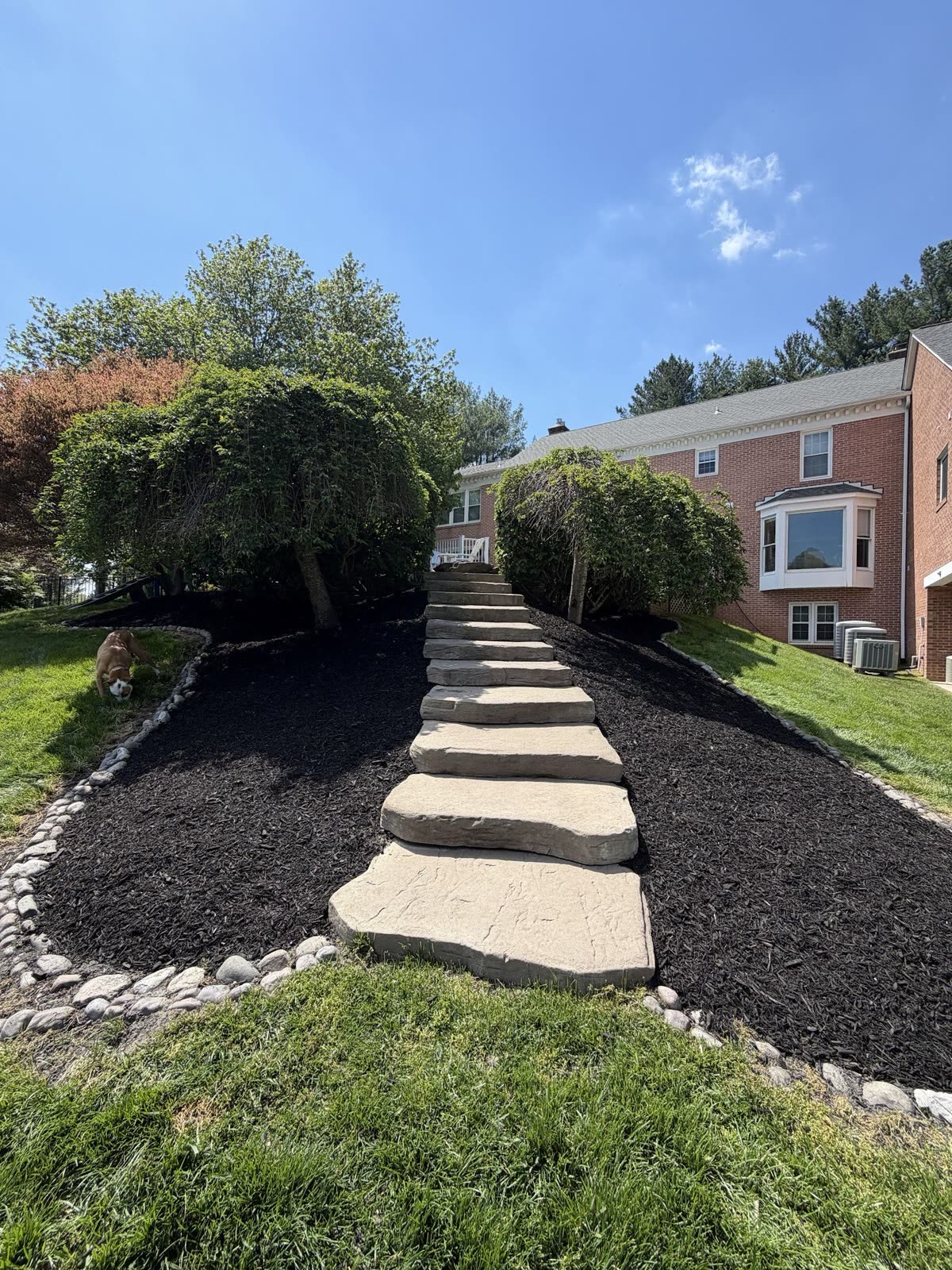
Choose a walkway material and shape by how people actually approach the door, then edge it so beds and lawn stay clean around it. A good front walk should guide the eye and the foot. Green Diamond Landscaping LLC builds stone and paver walkways and paths through our hardscaping service, and Eldersburg is one of our priority service areas.
This guide covers the styles, materials, width, edges and plantings to think about before you pick a layout.
What walkway styles suit a front yard?
The best style is the one that matches the way people walk to your door. A straight path suits a formal entry, a gentle curve suits a relaxed yard, and stepper stones suit a lawn you want to keep open.
Start by watching the route your family and your guests already take. Worn grass shows the natural line. A walkway that follows that line gets used. One that fights it gets cut across.
Here are the common styles:
- Straight path. Direct and clean, and a good match for a front door set square to the street.
- Curved path. Softer, and it can slow the approach so the front of the house comes into view slowly.
- Stepper stones. Large stones set in grass or gravel, with gaps between them. They work for a side path or a lighter-use route.
- Paver walk. Cut pieces laid in a pattern for a firm, even surface from the driveway or curb to the door.
A path made for guests should feel obvious. They should see where to go without a sign. That is what we mean by a walk that can guide the eye and the foot.
Should a front walk be stone or pavers?
Use pavers for a main walk that sees daily traffic and needs an even surface. Use natural stone or stepper stones when you want a more casual, garden-style look, or a secondary path.
Pavers are made in uniform shapes, so they fit together tightly and make a flat, even surface. That is helpful for strollers, packages, and guests carrying bags. Stone has more variety in shape and color, which gives a natural look but can leave bigger gaps.
Think about the way the path will be used:
- Daily walk from the driveway to the door: pavers often fit best.
- Side path to a gate or garden: stepper stones can be enough.
- Mixed use: a paver main walk with stepper stones branching off.
Ask how the base is prepared. The material you see is only the surface. A well-built base keeps the walk level, and that is where much of the work happens.
How wide and how straight should the path be?
A main front walk should be wide enough for two people to walk side by side, while a side path can be narrower. Width sets the mood: wider feels welcoming, narrower feels tucked and private.
Keep a few rules of thumb in mind. Make sure the walk is wide enough that someone carrying groceries does not step into the beds. Leave room where the walk meets the driveway, the porch or the steps, so there is a clear landing and not a narrow pinch.
Straight is not always best. A slight curve can look natural, and it can steer people around a tree or a bed. But a path with too many bends can feel confusing. If a visitor cannot see the door from the start of the path, simplify the shape.
If you have a Baltimore County or Carroll County property with a slope, tell us. A walk that crosses a grade needs thought about steps and water flow, and we can talk it through on site.
What belongs along the edges of a walkway?
Edges belong to the walkway as much as the surface does. A firm edge keeps stones or pavers from shifting and keeps lawn and mulch from creeping onto the path.
There are a few common choices:
- A neat trimmed lawn edge for a simple, low-cost-of-effort look
- A defined bed edge that separates mulch from the walk
- Border stones or a row of pavers set along the sides
Pick the edge based on what you will maintain. A crisp edge looks great but needs regular trimming. A hard edge holds longer between visits.
Lighting and house numbers also belong in the edge plan. Small path lights make the way easy to see at night, and they are easier to set before the planting goes in.
How does a walkway tie into beds and plantings?
A walkway ties in best when the beds beside it are shaped to follow it and the plants sit back far enough not to spill onto the path. The walk and the beds should look planned together.
Plants that grow wide can crowd a path in a season. Leave room for growth, and keep taller plants toward the back of the bed. Low plants near the edge keep the path open and the view clear.
Our landscaping service in Eldersburg can combine the walkway and the planting plan in one visit. That way the stone, the edging and the beds are built to match, rather than added at different times.
If your yard has an older walk, the same idea applies. Sometimes an old path can stay if the base is sound, and the beds and edging are what need work.
What does Green Diamond do before the work starts?
We walk the property with you before anything is scheduled. That lets us see the door, the driveway, the grade and the beds, and hear how you use the front yard.
Green Diamond is a family-owned landscaping and lawn care company based in Reisterstown, MD. Our service areas page describes Eldersburg as a priority area, just down Liberty Road from our Reisterstown shop. We serve homes within about 25 miles of Reisterstown, across Baltimore County and Carroll County.
Come to the walk-through with a few things ready:
- Photos of the front yard from the street and from the door.
- A sense of who uses the walk and how often.
- Any spots where water collects after rain.
- The look you like, such as formal, relaxed or garden-style.
We also respond to requests the same day. If you want a walkway that fits your Eldersburg home, call Green Diamond Landscaping LLC at (410) 847-9393 for a free estimate.
Frequently Asked Questions
Can I put a stone walkway over my old concrete path?
Sometimes, but it depends on the condition and height of the old slab. Cracked or sinking concrete may need to come out first. We look at it during the walk-through and explain the options.
Will stepper stones work in a high-traffic yard?
They suit lighter use, like a side path or garden route. For a daily route to the front door, a continuous paver walk is usually easier to walk on, especially with bags or a stroller.
How do I keep weeds out of the gaps?
A well-prepared base and tight joints help the most. Gaps that stay open invite weeds, so regular sweeping and tending the edges also matter. Ask about this when you plan the walk.
Should the walkway match my porch or steps?
It helps when the colors and style work together. The walk does not have to match exactly, but it should look like it belongs with the steps, the siding and the beds around it.